Reimagining the Employment Pass Services Centre for 2030
The Employment Pass Services Centre sees 460 new arrivals a day — the moment Singapore officially becomes home for a new pass holder. With the operating contract expiring in 2027, MOM needed more than a refurbishment: a shared vision, aligned concepts across three divisions, and a roadmap that could survive a tender. I was one of two designers on the Accenture Song team that produced it.
Highlights
Research that reframed the brief
A co-created direction
Cross-division alignment
Vision and roadmap
My contribution
Visual communication
Owned the visual design across all deliverables — Discovery Findings Report, co-creation materials, senior playback decks, alignment workshop assets, and the 44-page Experience Vision Pack.
Research and synthesis
Co-conducted and took notes across six in-depth interviews, then co-synthesised them into five insights. Co-authored the narrative framing across all five project phases.
AI-assisted production
Used Claude for interview transcripts and benchmark material, Gemini for supporting imagery, and Figma's MCP integration to speed up deck production — craft tools, not shortcuts for thinking.
The challenge
Three divisions — WPD, CXD and FWPD — each held a different picture of what a better EPSC would look like. The work needed to bring them to one shared vision, not just produce good ideas in a report.
MOM also needed to validate known improvement areas and define concepts concrete enough to feed into the FY27 tender — all within constraints that could not move.
Fixed operations
In-person fingerprinting and photo capture remain mandatory under an MHA requirement through 2030. The core transaction does not change.
Fixed site
MOM intends to stay at the current location within its existing footprint. The vision had to work within the space it already has.
Cost discipline
New lines of business must justify their cost. The vision needed to be ambitious enough to matter and realistic enough to survive a commercial tender.
Interview research and findings
We ran sacrificial concepts alongside open questions — rough provocations designed to surface genuine reactions rather than recalled preferences. Presenting an idea the participant could agree or disagree with gave us richer signal than asking them to describe what they wanted.
Interviews conducted
6
Duration each
60–75 min
Nationalities
5
Pass types covered
6
Interview participants
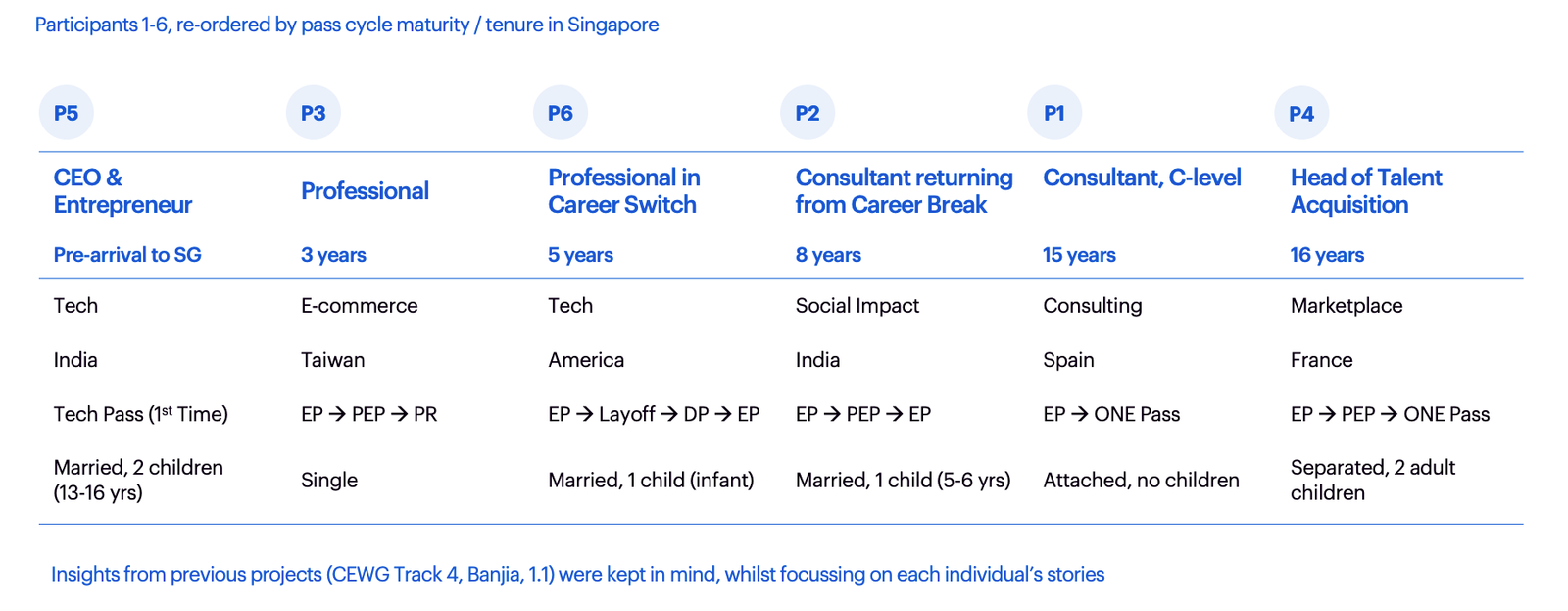
The research surfaced five insights across the EP holder journey. The stress of the visit begins long before arrival — and for most people, it releases the moment they walk out of EPSC. After that, MOM fades from view until life transitions bring it back. Passes are not just administrative documents; they carry personal and financial stakes that make every process hiccup land hard. And the real support network for EP holders is not MOM — it is their expat community.
Our findings
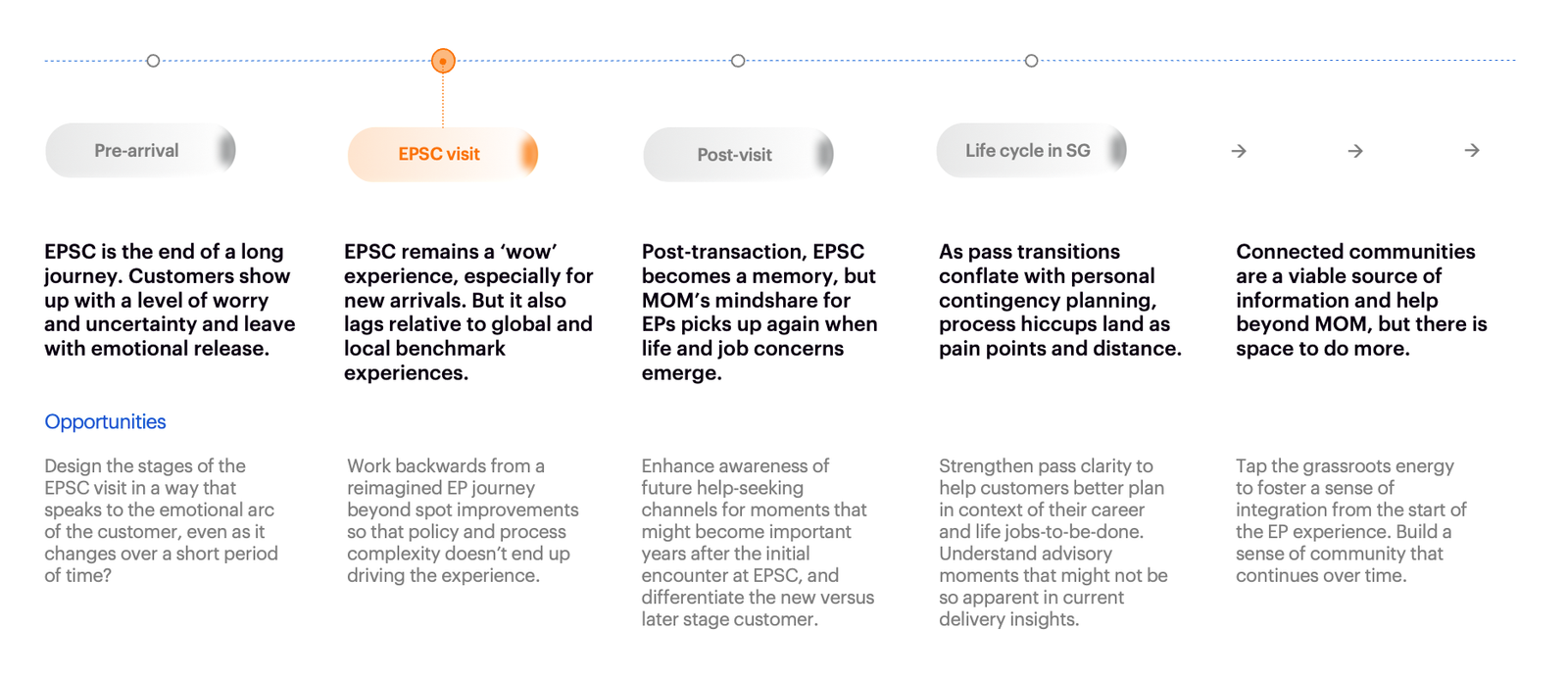
Understanding the current EPSC service flows
Before moving into ideation, we mapped EPSC's three service flows against a 5R framework — Remain, Remove, Rework, Rewire, and Reimagine — to give the client a structured basis for what should carry forward, what needed redesigning, and what could be built entirely anew. This grounded our direction in operational reality before we stretched toward future possibilities.
Service 01: Pass Registration Transaction
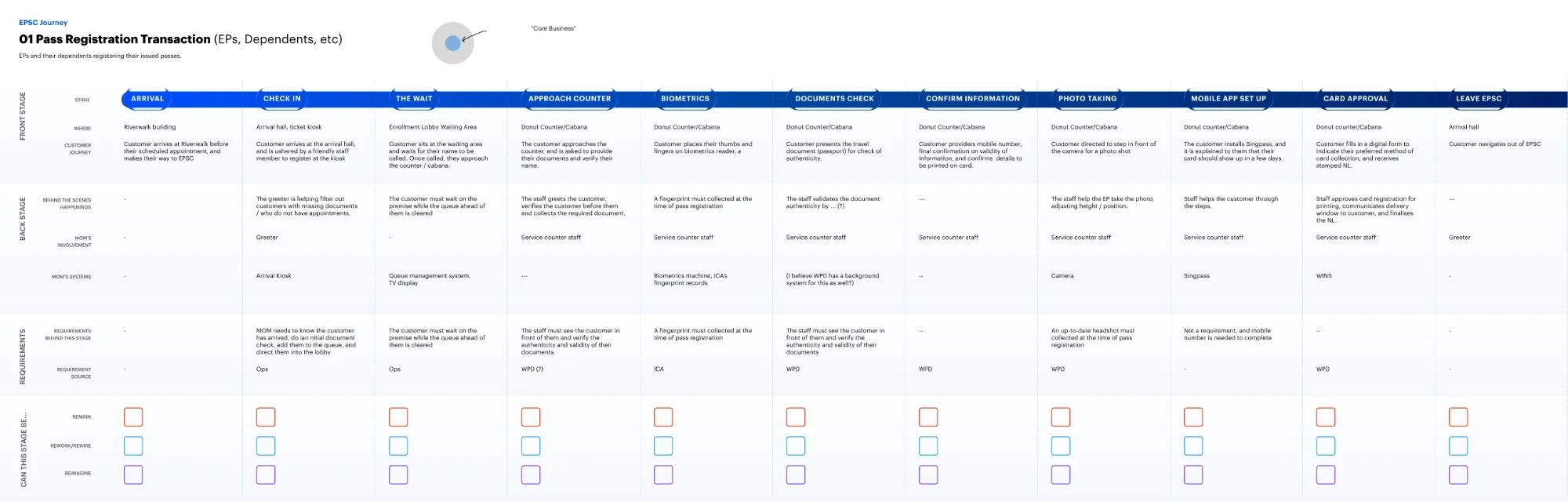
The highest-footfall, most complex flow — EPs and dependents registering their issued passes. Biometrics was the one step expected to remain due to policy constraints, with the greatest reimagination potential in the wait, approach counter, and departure moments.
Remain
Biometrics
Remove / Rework / Rewire
Arrival + Check-in + Approach Counter, Travel Documents Check, Photo Taking, Confirm Info + Indicate Collection
Reimagine
The Wait, Approach Counter, Biometrics + Photo Taking, Arrival + Leave EPSC
Service 02: Pass Issuance Transaction
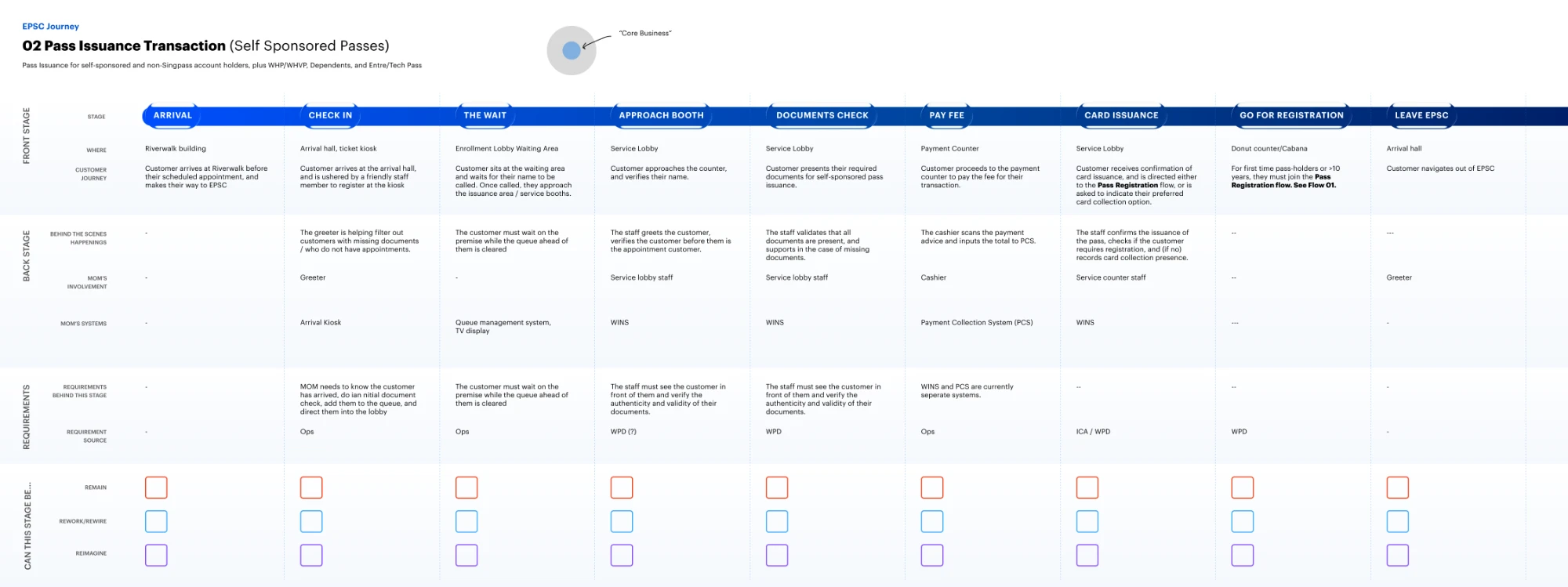
Self-sponsored passes and non-Singpass account holders. No steps were expected to remain unchanged — the highest potential for end-to-end redesign across all three flows.
Remove / Rework / Rewire
Check Letters / Declarations, Travel Documents Check, Payment
Reimagine
Arrival, Check In, Wait, Leave EPSC
Service 03: Card Collection
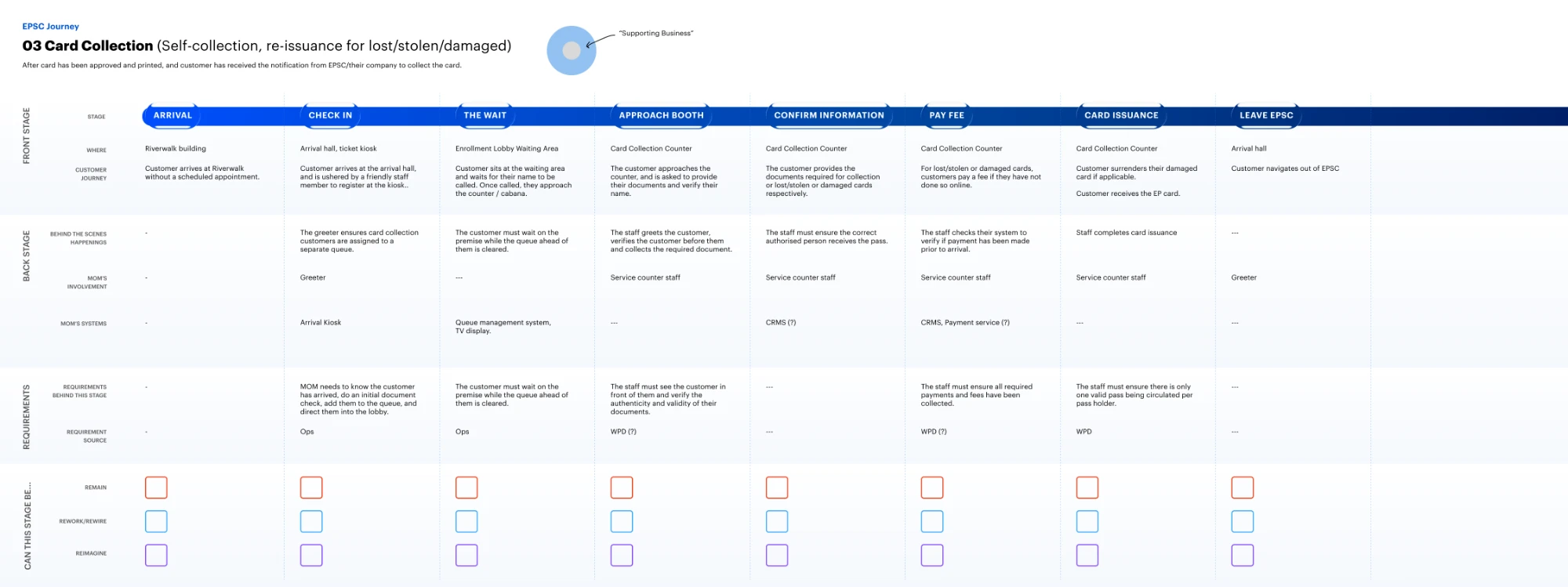
Self-collection and re-issuance for lost, stolen, or damaged cards — categorised as supporting rather than core business. Like Service 02, no steps were expected to remain unchanged.
Remove / Rework / Rewire
Approach Booth, Confirm Information, Pay Fee, Card Issuance
Reimagine
Arrival, Check In, Wait, Leave EPSC
Four cross-cutting opportunities emerged — none solvable by fixing a single flow, all addressable by a reimagined EPSC.
1
Biometrics and photo capture can be enlivened
2
Pre-registration friction can be reduced
3
Documentation burden can be lifted from both sides
4
Waiting time is an untapped opportunity
Global inspirations and co-creation workshop
Before the co-creation sessions, we developed five thematic provocations drawn from global retail, hospitality, travel, and technology examples. Each theme was anchored in a "Thought Starter for MOM" question to keep the inspiration actionable and grounded in EPSC's specific challenges.
Global inspirations
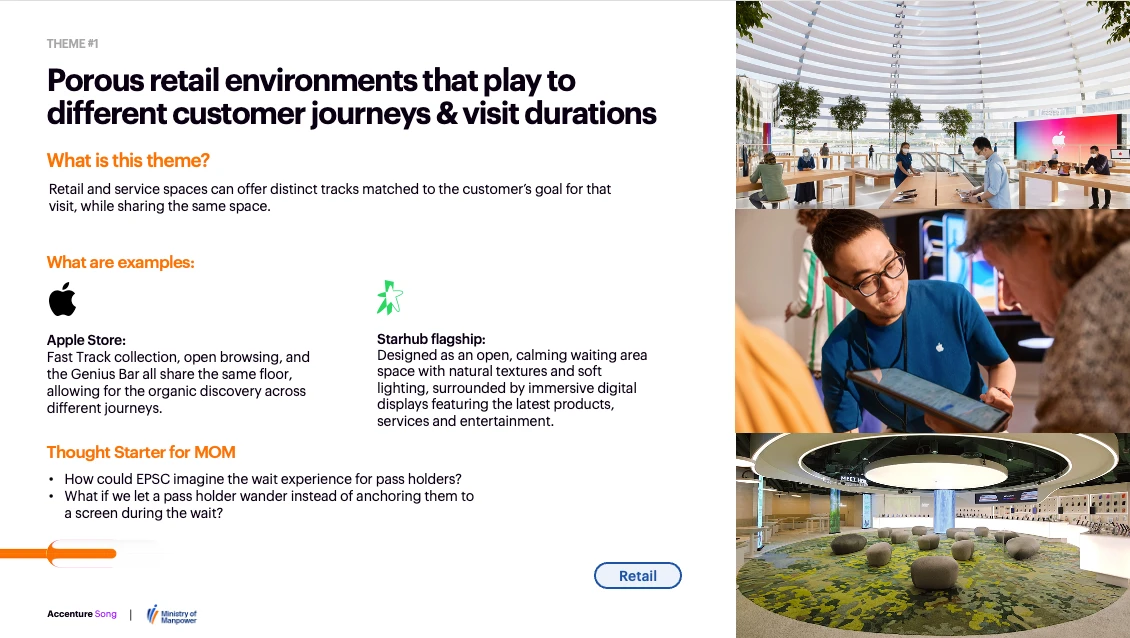
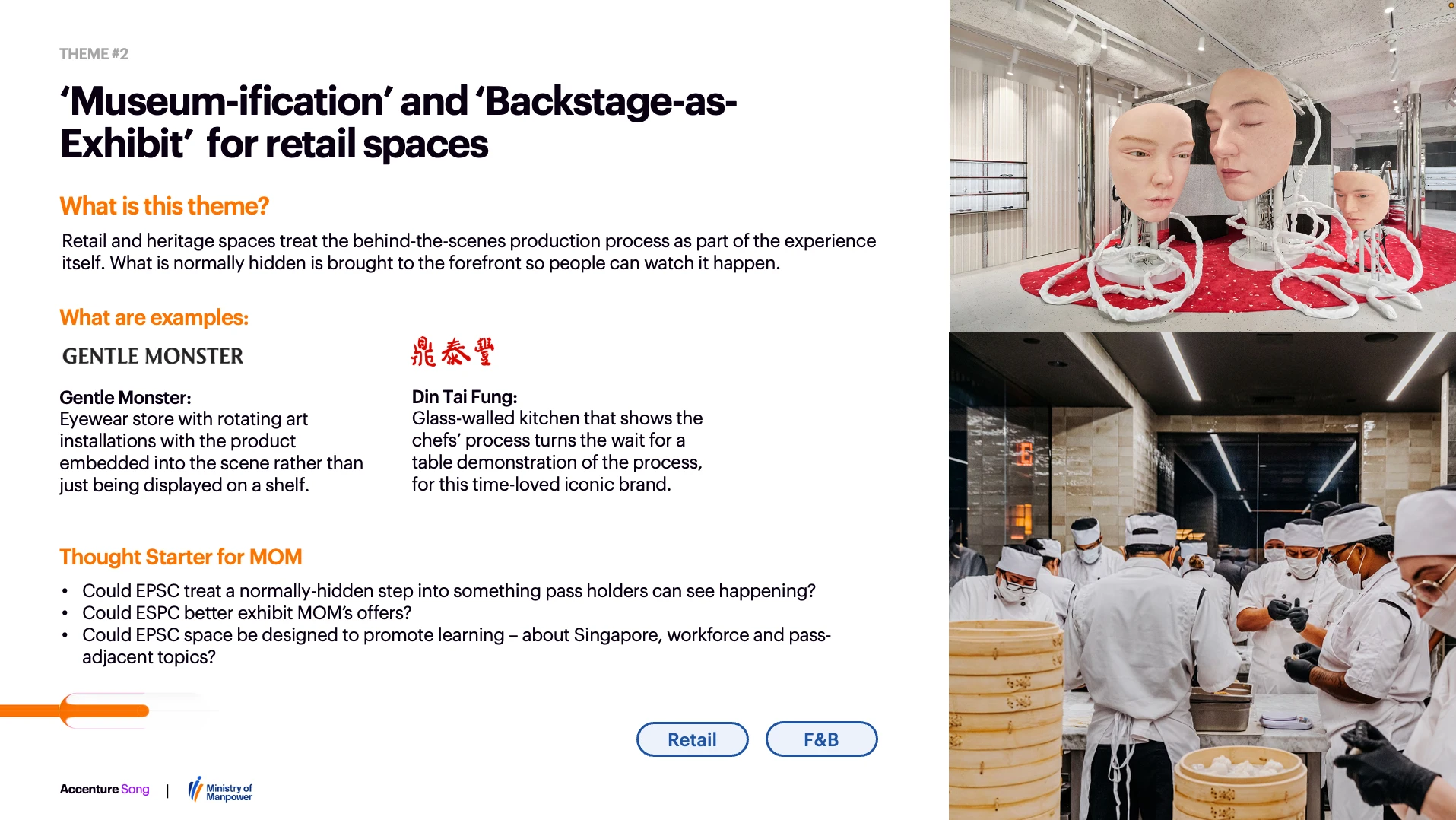
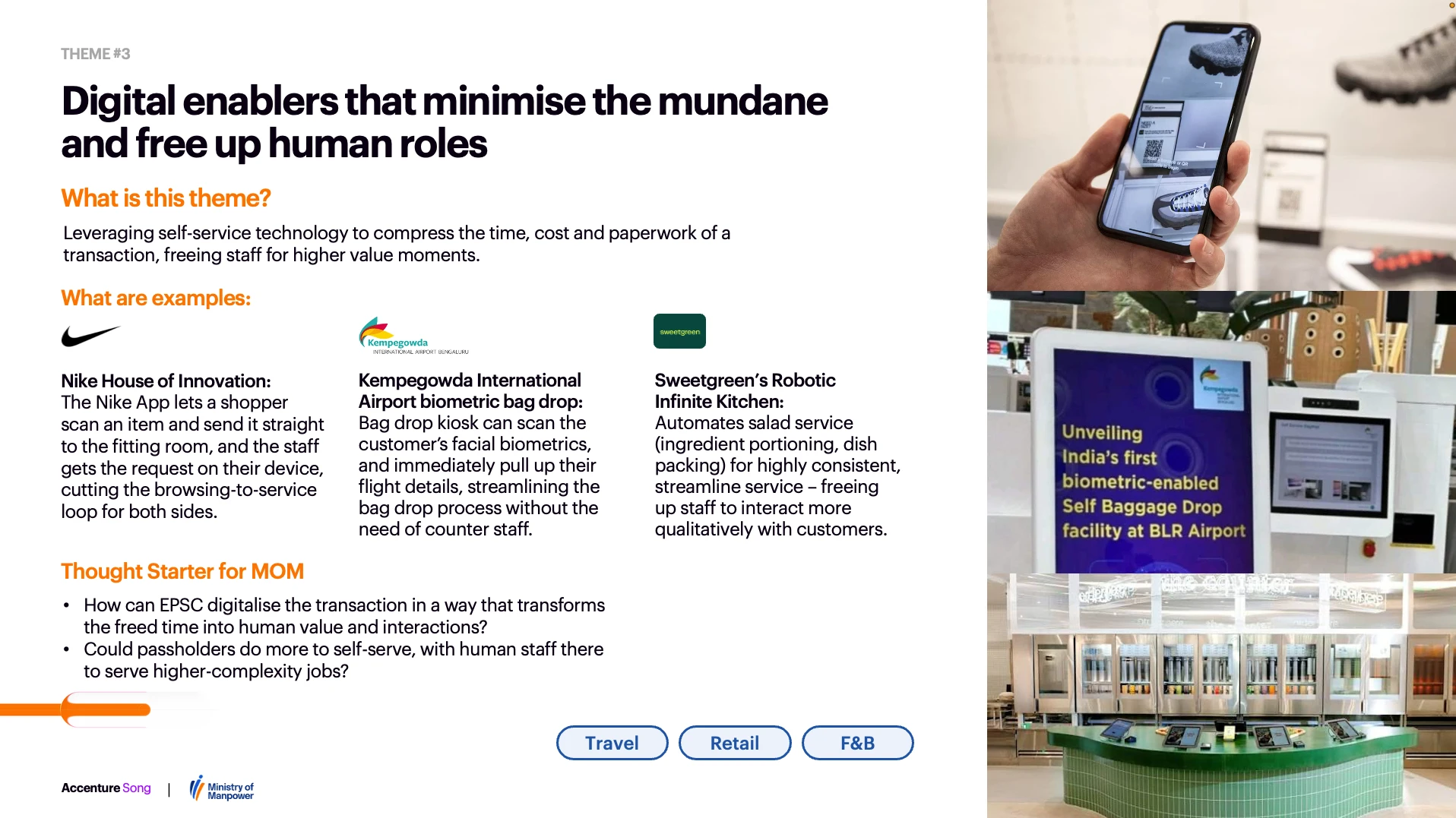
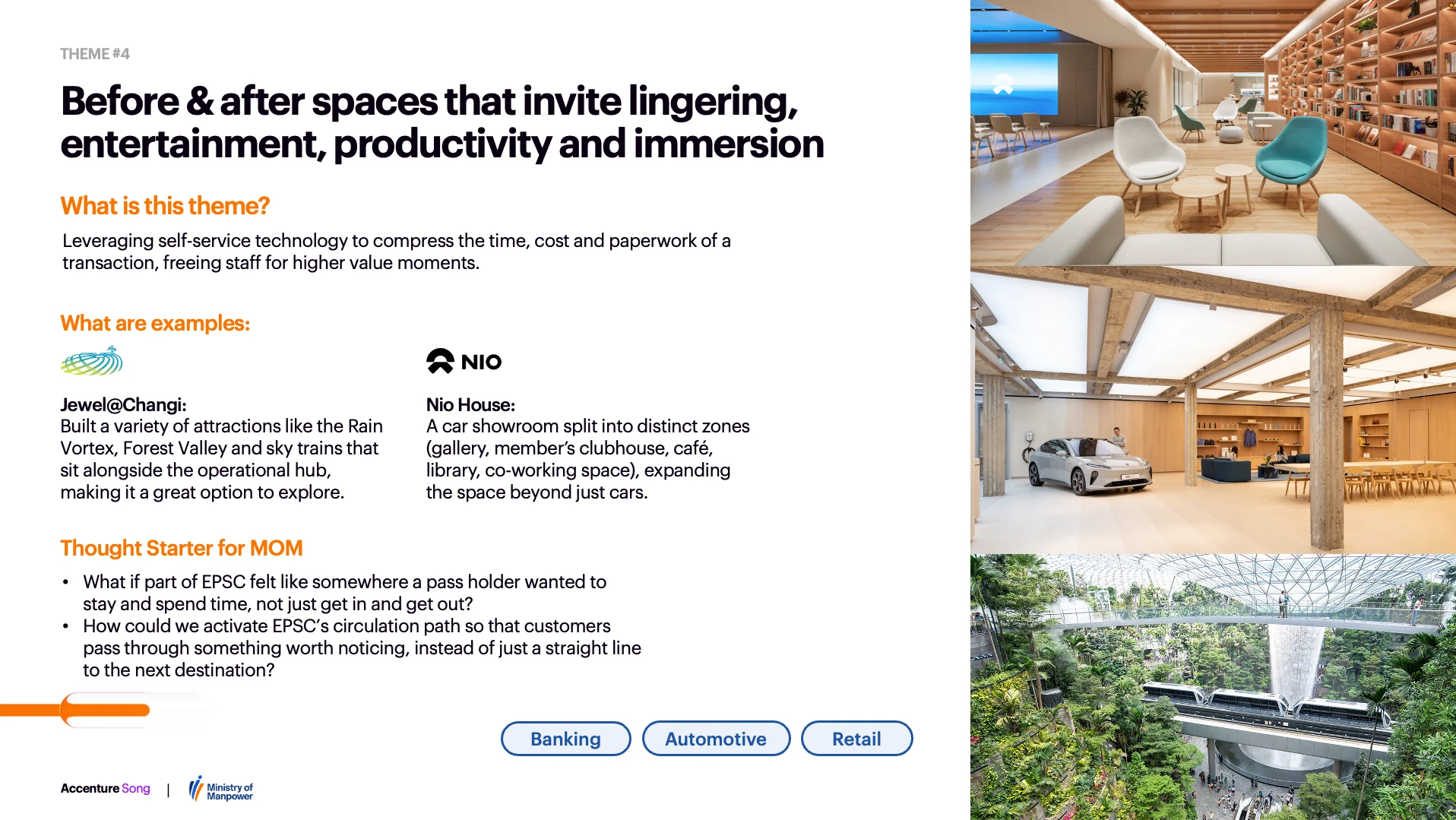
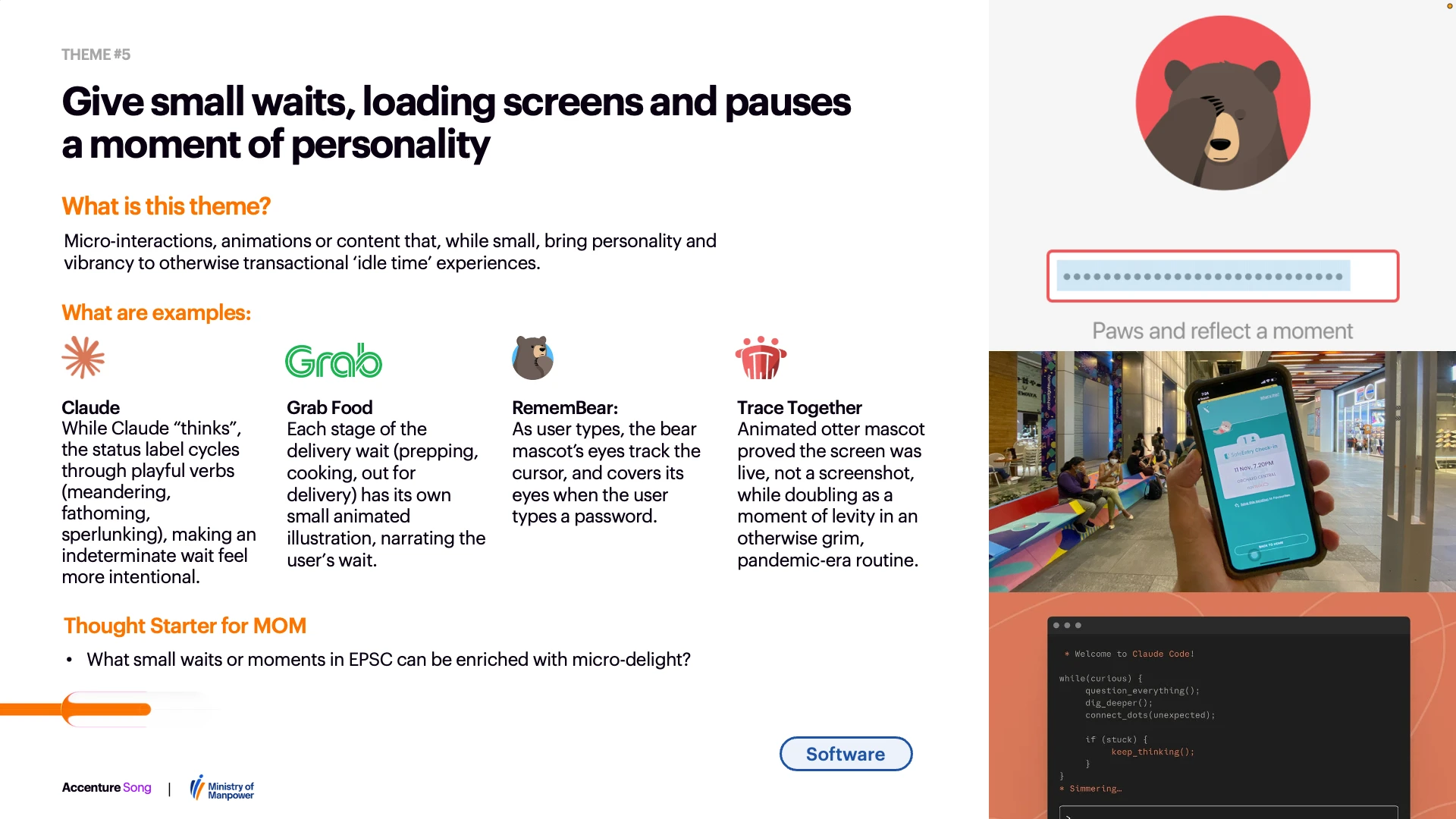
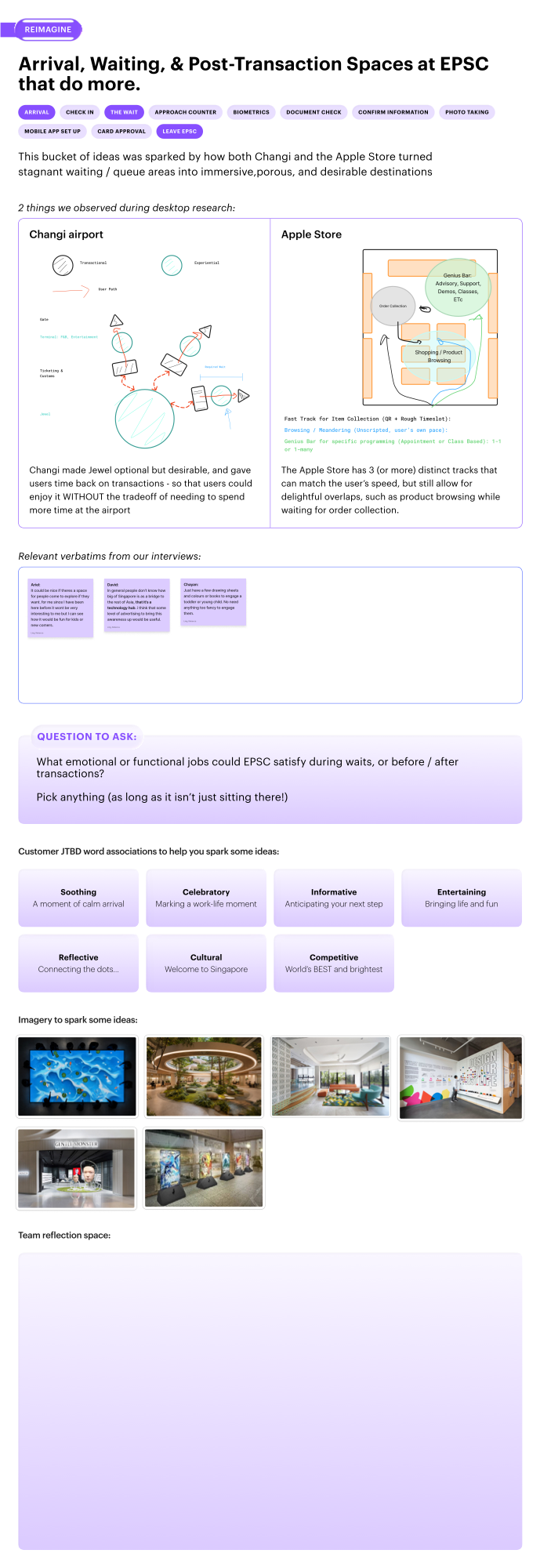
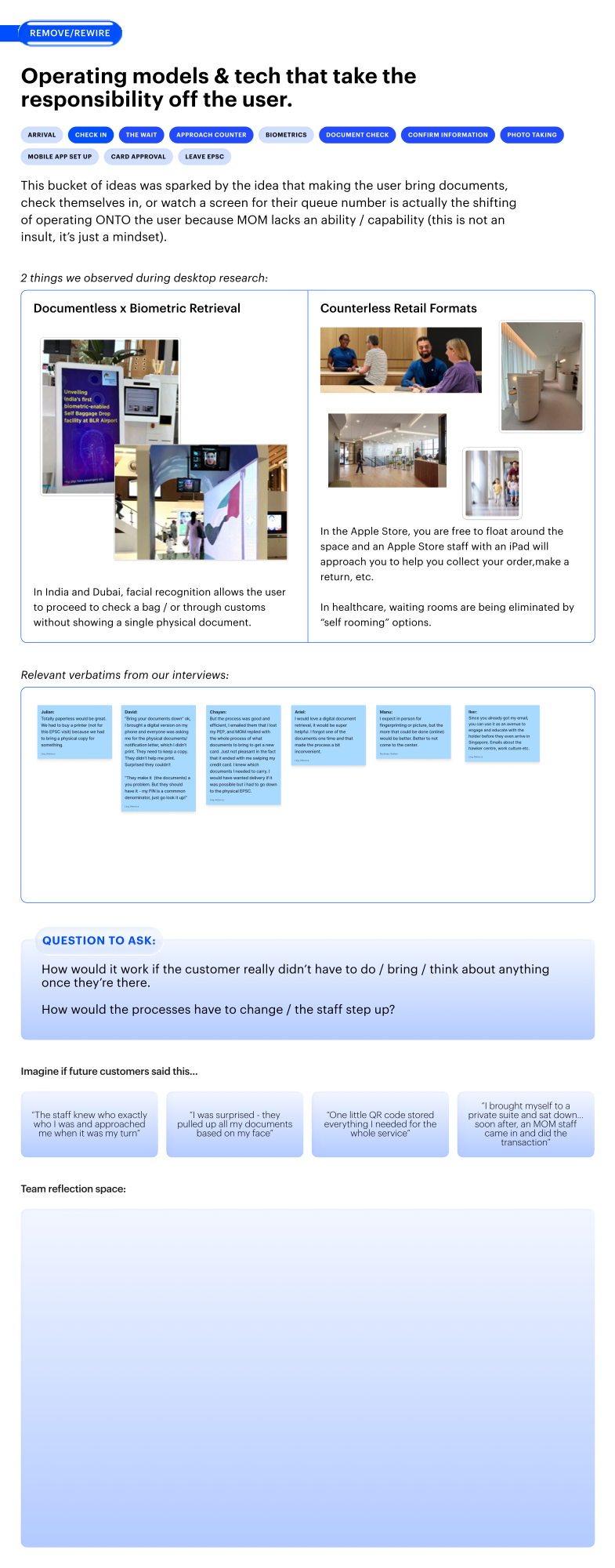
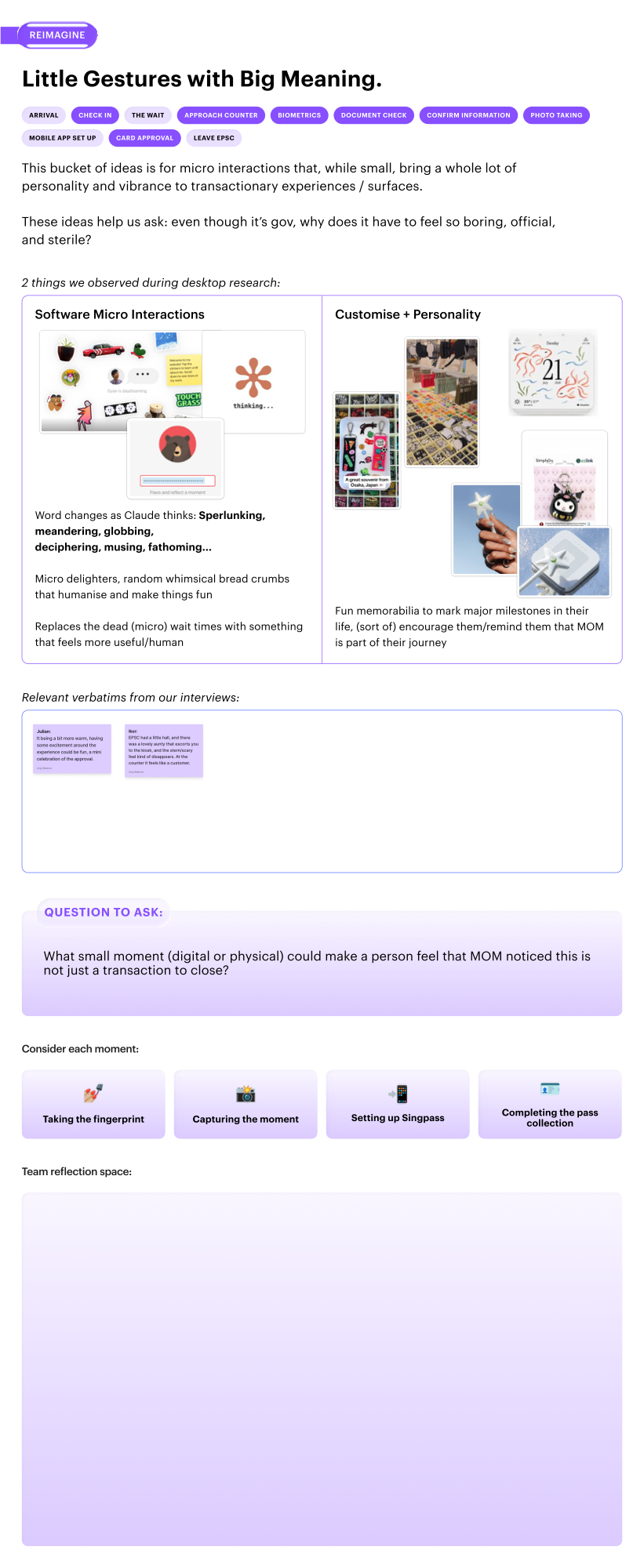
Using the global inspirations, current service analysis, and interview verbatims as inputs, we developed a set of Ideation Platforms to give the working team a high-quality jumping-off point for ideation. Each platform offered a traceback to the inspiration that sparked it, relevant customer verbatims, a "How Might We" question, and visual stimulus to prime ideas. The Accenture Song team then facilitated 3–4 working sessions with CXD, WPD, and FWPD officers, using these platforms to generate a backlog of ideas for EPSC 1.5.
01 — Spaces at EPSC
02 — Operating Models
03 — Microinteractions
Shaping the direction
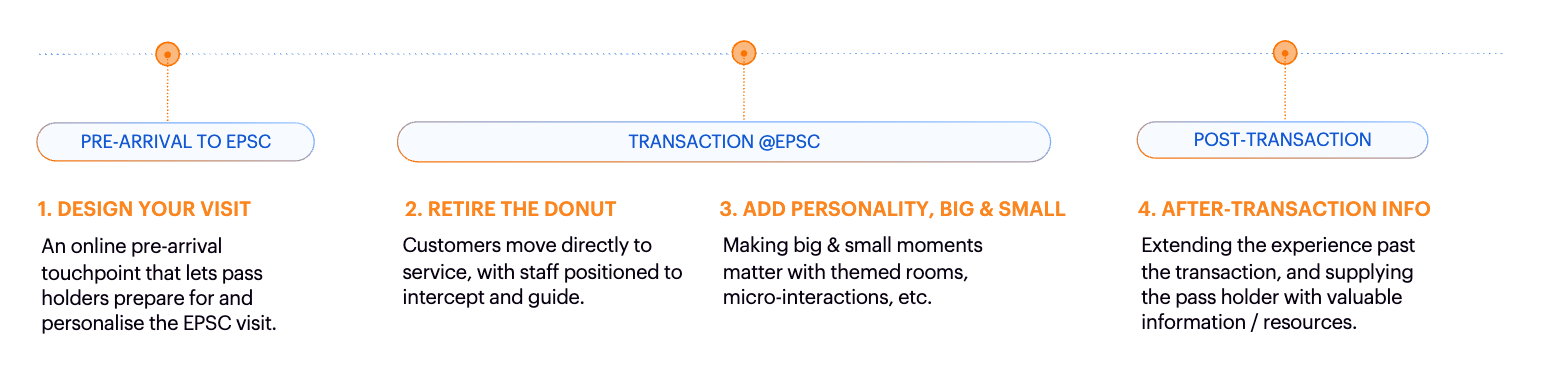
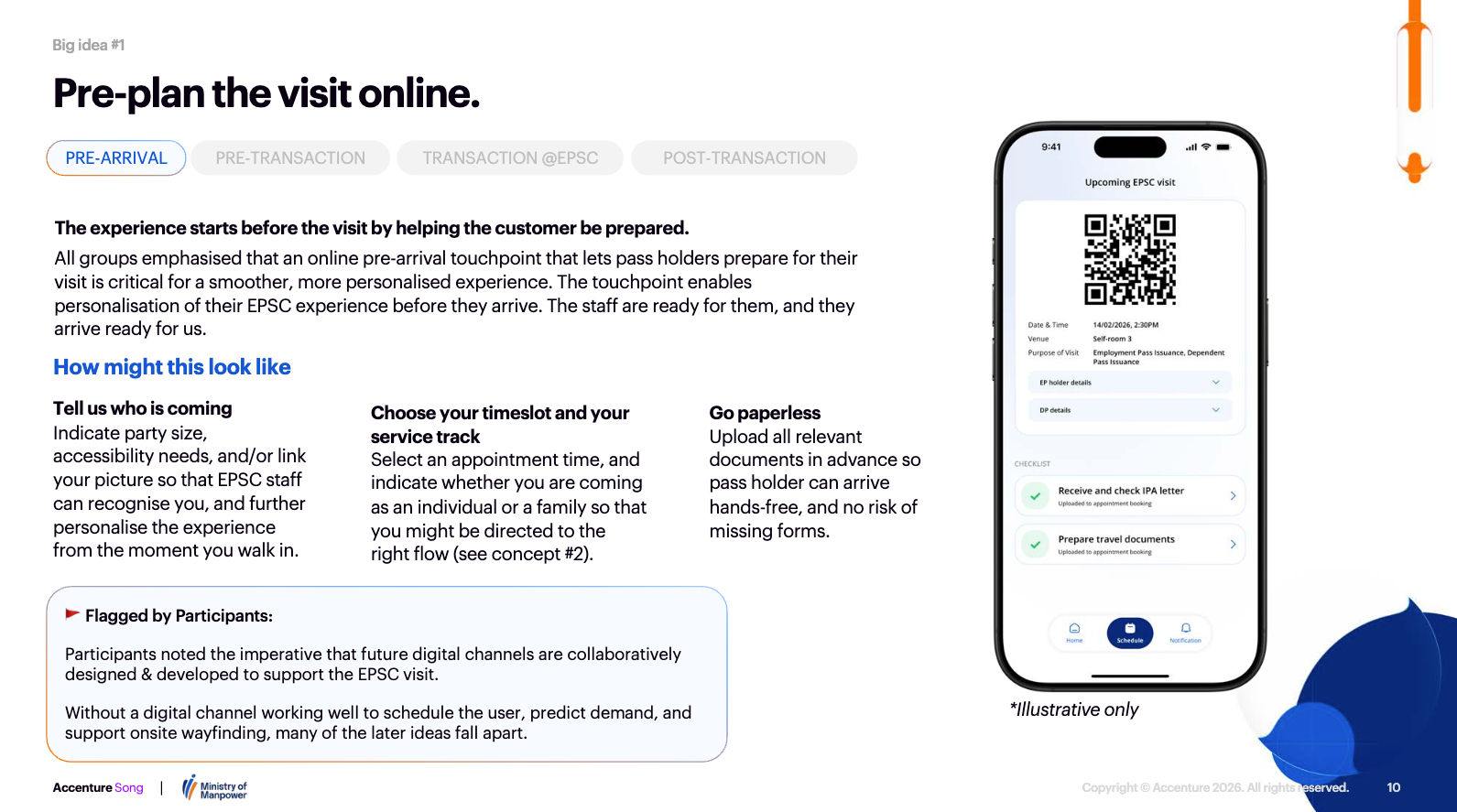
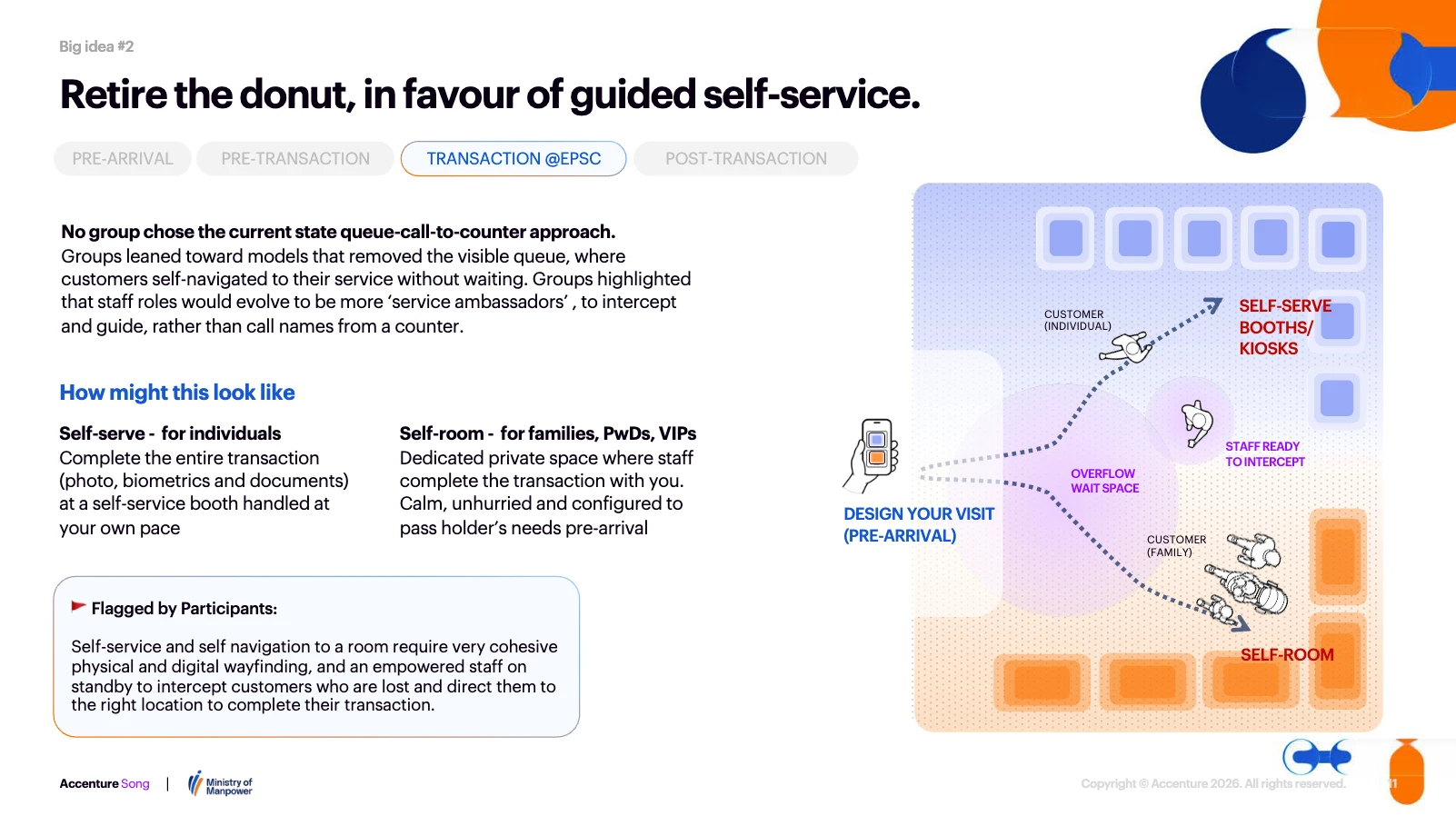
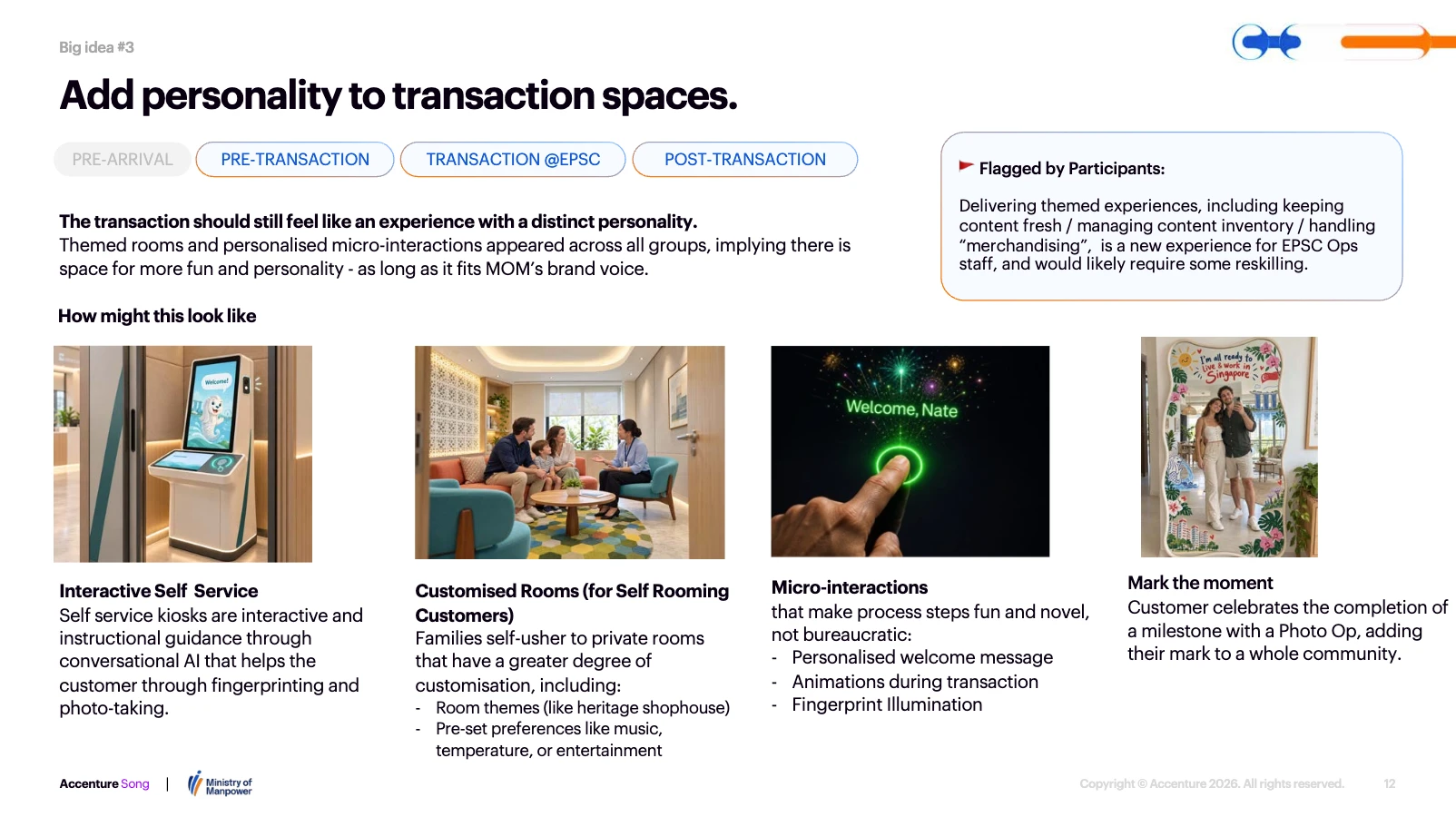
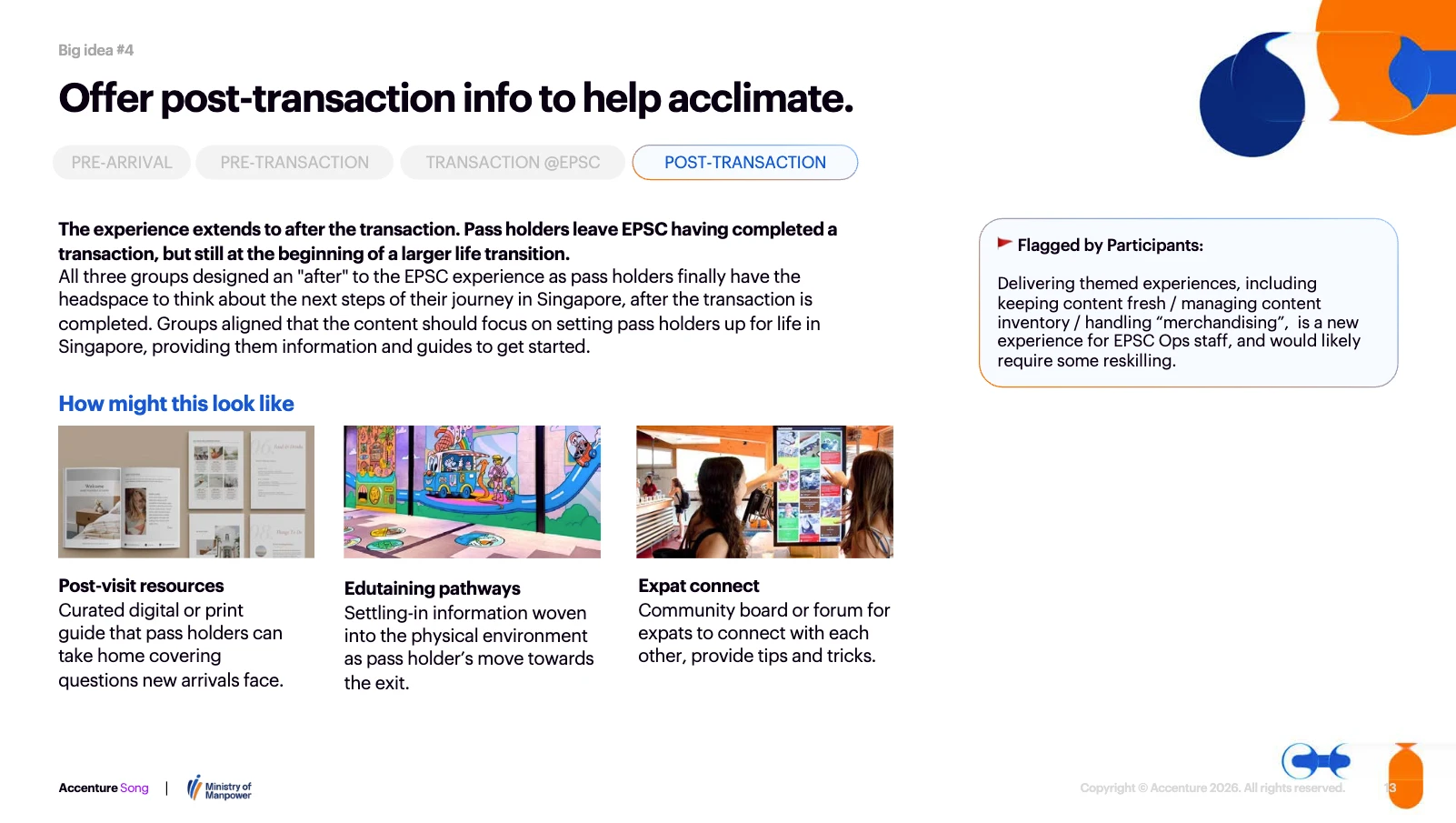
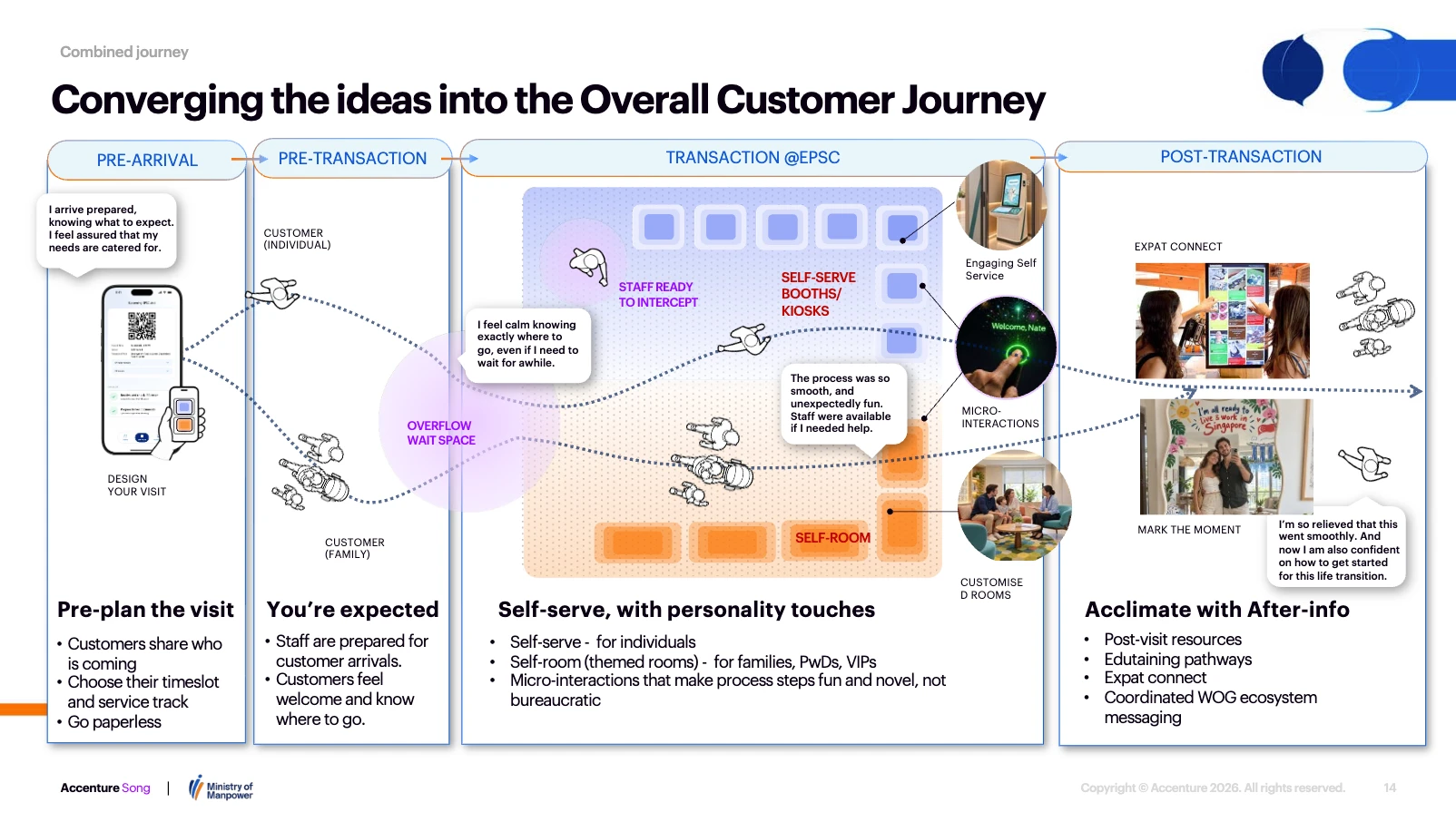
Four ideas emerged — one per stage of the journey. No group chose to retain the current queue-to-counter model, including the operational leads who run it. Grounded in interview insights and co-creation outputs, the four ideas were converged into the experience vision that shaped MOM's FY27 tender brief.
The vision
The vision and roadmap give MOM a shared frame heading into the FY27 tender brief — with 14 initiatives mapped against clear owners and timelines, and three divisions aligned on a single direction for the EPSC experience.
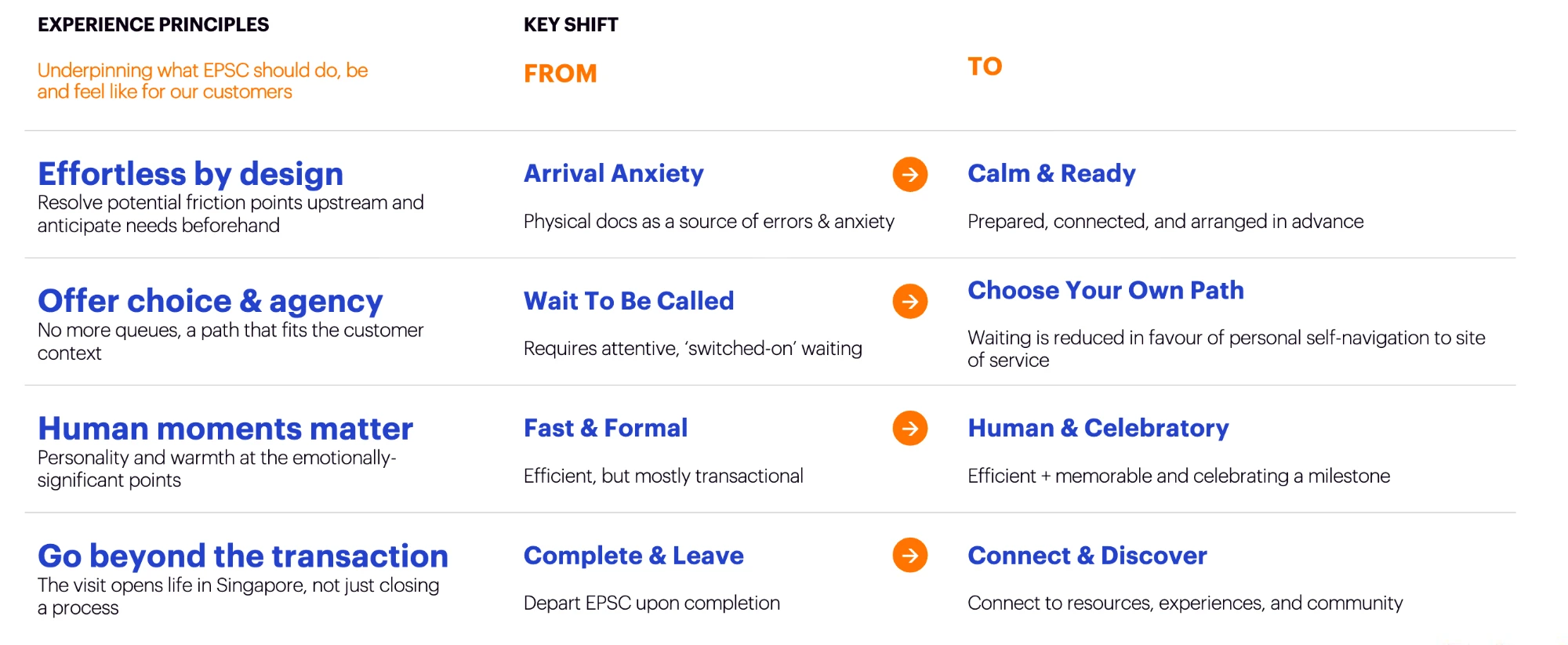
Four principles
Experience Vision Pack
44 pages · 14 initiatives
Journey storyboard
3 types · 4 stages · 13 sub-stages
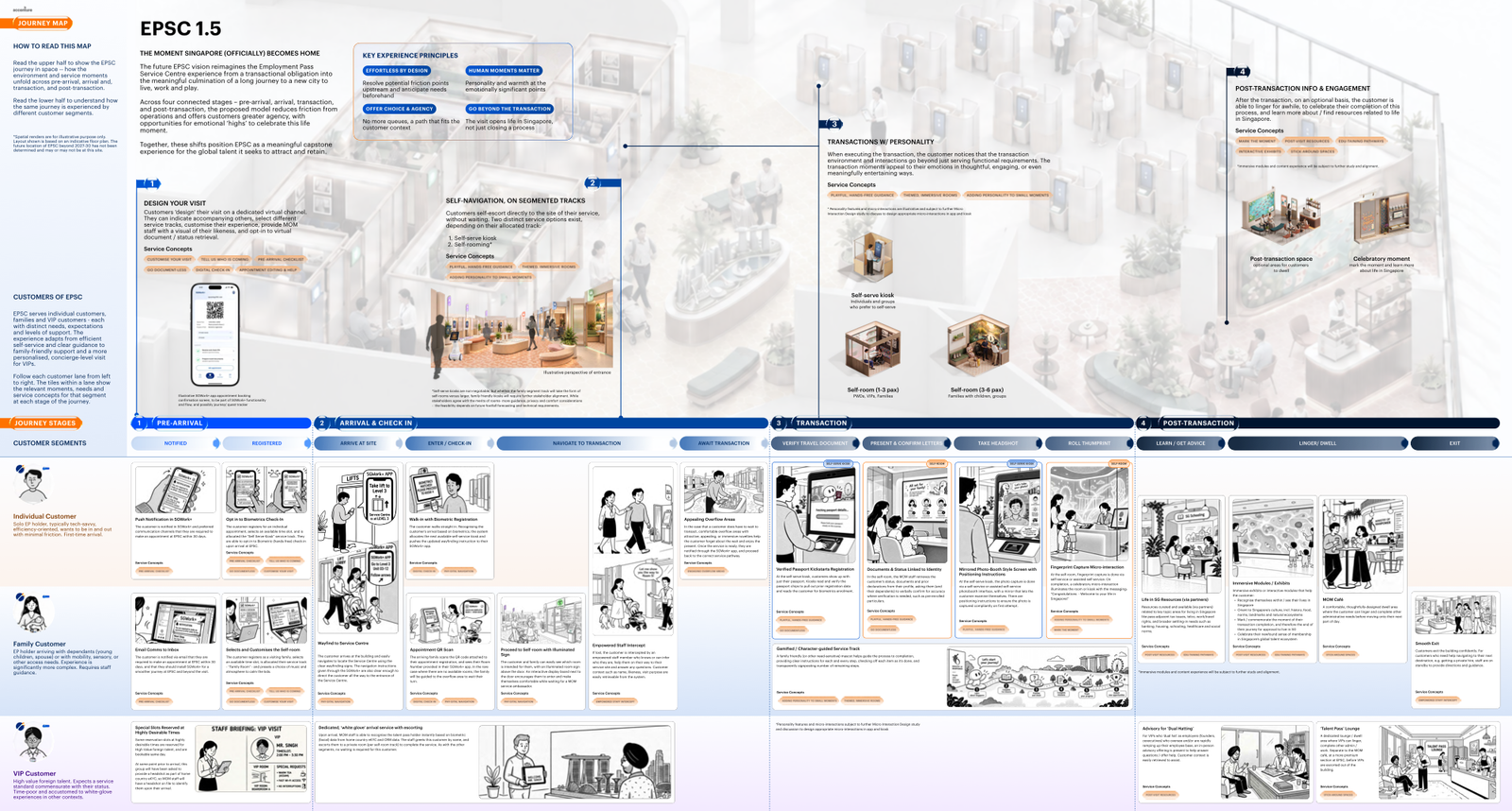
Pre-arrival — Design Your Visit
Built into SGWork+ as a single module. Must still work for customers who arrive unprepared.
Arrival — Self-Navigation on Segmented Tracks
Kiosk model confirmed. Track format depends on footfall data — deferred to next phase.
Transaction — Transactions with Personality
Must not add time or steps. Micro-interaction design deferred to Q1 2027.
Post-transaction — Info and Engagement
Post-transaction content lives in SGWork+, not on-site.
Reflection
What worked
The relationship with CXD. Twice-weekly check-ins meant their feedback shaped every draft in real time, not just at milestone reviews. That cadence — close, frequent, iterative — is something I want to replicate.
What was hard
Running workshops at this scale while requirements kept shifting. I learned that the brief you write for a session often changes after the one before — and that building in flex is not a weakness, it is the work.
What I would do differently
Push earlier for a sharper scope boundary between the vision and what the tender can realistically carry. The ambition was right; the translation layer needed more explicit design.